Table of Contents
Buying an engagement ring is exciting, but it can also create one big question: How much should you spend on an engagement ring?
You may have heard that you should spend three months' salary. You may have seen rings priced at $1,000, $5,000, or even $20,000 and wondered what a "normal" budget actually looks like.
The truth is simpler than the old rules suggest: there is no universal amount you should spend on an engagement ring.
Your ideal engagement ring budget should reflect your income, savings, existing financial commitments, your partner's expectations, and the type of ring you want. A beautiful engagement ring can be meaningful at almost any budget when you know where to prioritize your money.
According to The Knot's Jewelry and Engagement Study, the average U.S. engagement ring cost was $4,600 in 2025. However, The Knot emphasizes that this is a data point rather than a required spending target.
So, whether your budget is $1,000 or $10,000, the goal isn't to spend as much as possible. It's to find the best engagement ring for your budget.
How Much Does an Engagement Ring Cost in 2026?
There is a very wide range of engagement ring prices.
A simple ring with a modest center stone can cost under $1,000, while a high-quality natural diamond in a platinum setting can cost many thousands of dollars.
GIA notes that there is no hard-and-fast rule for how much an engagement ring should cost.
Industry estimates may place many U.S. purchases in the $5,000–$7,500 range, but many couples spend less than $3,000, while others spend considerably more.
The important point is that the average price shouldn't determine your personal budget.
Instead, ask:
What can I comfortably spend without creating financial stress?
That number is your starting point.
Is the Three-Month Salary Rule Still Relevant?
Probably not.
The famous three months' salary engagement ring rule is an advertising tradition rather than a financial requirement.
The concept originated with diamond-industry marketing during the Great Depression. The original campaign promoted spending one month's salary, and the suggested amount later evolved into two and eventually three months.
Today, jewelry and financial experts generally recommend considering your actual financial situation instead of following an arbitrary salary formula.
The Knot similarly advises buyers to set a realistic budget based on their lifestyle rather than treating the three-month rule as an obligation.
So if three months of your salary is $12,000 but spending $12,000 would drain your savings or create expensive debt, you shouldn't spend $12,000 on the ring simply because an old rule says you should.
Your engagement should mark the beginning of your future together—not the beginning of financial stress.
Engagement Ring Budget by Price Range
One of the easiest ways to determine how much to spend on an engagement ring is to start with the amount you're comfortable spending and understand what that budget can realistically provide.
Engagement Rings Under $1,000
A $1,000 budget can still produce a beautiful and meaningful engagement ring.
At this price point, consider:
- Moissanite engagement rings
- Simple solitaire settings
- Smaller lab-grown diamonds
- 10K or 14K gold
- Minimalist designs
- Alternative gemstones
Moissanite can be particularly attractive for budget-conscious buyers because it offers strong brilliance and durability at a generally lower price than diamond. GIA describes moissanite as a popular diamond alternative with impressive sparkle and an accessible price point.
The key is not to judge a ring by its price tag. A thoughtfully designed $900 ring can be far more meaningful than an expensive ring chosen simply to impress others.
Engagement Rings Between $1,000 and $2,000
This is a highly flexible range for shoppers looking for an affordable engagement ring without sacrificing style.
Depending on the stone and design, you may be able to consider:
- Larger moissanite center stones
- Lab-grown diamonds
- Oval or pear-shaped stones
- Halo settings
- Hidden halo designs
- 14K gold
- Side stones
- Customization
This is also where choosing a different gemstone can dramatically change what your budget can achieve.
Instead of putting most of your money into a smaller natural diamond, you could consider a custom moissanite engagement ring with a larger center stone and a more detailed setting.
Engagement Rings Between $2,000 and $3,000
A $2,000–$3,000 engagement ring budget gives you even more flexibility.
Depending on the specific stone and setting, you could explore:
- Premium moissanite
- Larger lab-grown diamonds
- More elaborate halo settings
- Three-stone designs
- Hidden halos
- Detailed pavé bands
- Custom engagement rings
At this level, it becomes particularly important to decide what matters most to you.
Do you want a larger center stone?
A more intricate setting?
A specific diamond shape?
A premium metal?
Or a custom design?
Having clear priorities prevents you from spending money on features that aren't important to you.
Engagement Rings Between $3,000 and $5,000
This range overlaps with the current U.S. average engagement-ring spend.
With a $3,000–$5,000 engagement ring budget, shoppers can explore a broad range of designs, including higher-quality lab-grown diamonds, selected natural diamonds, premium settings and custom jewelry.
However, don't assume that reaching $4,600 automatically means you've chosen the "right" ring.
The Knot's current data places the 2025 average at $4,600, but explicitly describes the figure as a reference point rather than a requirement.
Your partner's preferences should matter more than the national average.
Engagement Rings Between $5,000 and $10,000+
At $5,000 and above, you can explore more premium combinations of center stone, setting and craftsmanship.
Depending on the stone type, this could include:
- Larger natural diamonds
- Higher-quality natural diamonds
- Premium lab-grown diamonds
- Platinum settings
- Intricate custom designs
- Larger moissanite with elaborate settings
- Multiple-stone engagement rings
But there is an important lesson here:
A $10,000 engagement ring isn't automatically better than a $2,000 engagement ring.
Price is only one part of the equation.
What Determines the Price of an Engagement Ring?
Understanding what you're paying for makes it much easier to set a realistic engagement ring budget.
1. The Center Stone
For diamond rings, the center stone usually has the biggest influence on price.
Diamond quality is evaluated using the 4Cs: Cut, Color, Clarity and Carat Weight. GIA developed the 4Cs as a global standard for describing diamond quality.
Cut
Cut affects how a diamond interacts with light and therefore has a major influence on brilliance, fire and scintillation.
A well-cut diamond can look dramatically more lively than a poorly cut diamond of the same carat weight. GIA's current guidance emphasizes the importance of cut in bringing a diamond's beauty to life.
Color
Diamond color ranges from colorless to light yellow or brown on the standard D-to-Z scale.
If you're trying to maximize your budget, you don't necessarily need the highest color grade.
GIA notes that G-to-J diamonds can provide a more budget-friendly option, depending on the setting and your visual preferences.
Clarity
Clarity refers to internal inclusions and surface blemishes.
Instead of automatically paying for flawless clarity, look at the actual stone.
GIA notes that VS2 and sometimes SI1 diamonds can offer good value because inclusions may not be visible to the naked eye.
Carat Weight
Carat measures a diamond's weight—not simply how large it looks.
A larger carat weight usually costs more, but bigger isn't always better.
A well-cut 0.90-carat diamond can look more impressive than a poorly cut one-carat diamond.
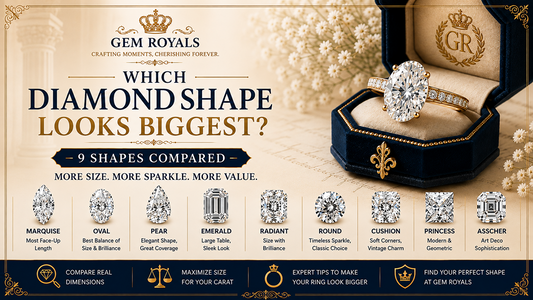
2. Diamond Shape
The shape you choose can also influence your engagement ring cost.
Popular shapes include:
Round brilliant diamonds are often among the more expensive shapes, while some fancy shapes can provide a different visual appearance for the money. GIA notes that round diamonds can command higher prices because of their popularity and cutting characteristics.
If visual size is important to you, compare several shapes before deciding.
3. Ring Setting
The setting can have a surprisingly large impact on your final price.
A simple solitaire may cost less than a halo, three-stone or pavé design because intricate settings require additional materials and craftsmanship.
However, a detailed setting can sometimes make a smaller center stone appear larger.
That means spending more on the setting isn't necessarily wasteful—it can actually be an effective way to create the look you want while keeping the center-stone cost under control.
4. Metal
The metal also contributes to the overall engagement ring price.
Common choices include:
GIA notes that platinum is generally more expensive because of its rarity and properties, while gold offers several attractive options at different price points.
Choose the metal based on appearance, durability, lifestyle and budget—not price alone.
How to Get More Ring for Your Money
You don't always need to increase your budget to get a more impressive ring.
Sometimes, you simply need to spend differently.
Prioritize Cut Over Maximum Carat
If you're buying a diamond, prioritize a stone that performs well visually rather than simply chasing the highest carat weight.
Consider Near-Colorless Diamonds
A G or H diamond can provide a beautiful appearance without the premium associated with the highest color grades.
Consider Eye-Clean Clarity
You don't necessarily need a flawless diamond.
If inclusions aren't visible without magnification, paying significantly more for a higher clarity grade may not make a noticeable difference to the person wearing the ring.
Consider Just-Below Carat Weights
Certain carat weights can carry pricing premiums.
For example, GIA notes that stones such as 0.97 carats or 1.47 carats can sometimes cost less than 1.00- or 1.50-carat stones while appearing essentially indistinguishable in face-up size.
Consider Moissanite
If your goal is maximum visual impact within a defined budget, moissanite engagement rings are worth considering.
Moissanite is not a diamond; it is a separate gemstone made of silicon carbide. But its strong brilliance, durability and accessible price can make it an attractive choice for couples who want a larger or more distinctive ring without the cost of a comparable natural diamond.
Natural Diamond vs Lab-Grown Diamond vs Moissanite
Today's engagement-ring shopper has more choices than ever.
Natural Diamond
A natural diamond forms naturally within the Earth and is made of carbon.
It's a traditional choice for couples who value natural origin, rarity and the long-established symbolism associated with diamonds.
Lab-Grown Diamond
A lab-grown diamond is also diamond. GIA explains that laboratory-grown diamonds have the same crystal structure and are composed of carbon like natural diamonds; their primary distinction is their laboratory origin.
For buyers who specifically want a diamond but are looking for another price or sourcing option, lab-grown diamonds can be worth considering.
Moissanite
Moissanite is a different gemstone entirely.
It is not a lab-grown diamond and should not be represented as one. Instead, it's a diamond alternative with its own optical characteristics and strong durability.
For many budget-conscious shoppers, this creates an appealing choice:
Natural diamond for tradition.
Lab-grown diamond for diamond characteristics with a laboratory origin.
Moissanite for distinctive sparkle and value.
Don't Forget These Additional Engagement Ring Costs
Your engagement ring budget shouldn't stop at the sticker price.
Remember to consider:
Sales Tax
Depending on where you purchase and where the transaction is subject to tax.
Ring Resizing
If you aren't completely confident about the ring size, leave room for possible resizing.
Engraving
Personalized engraving can add a meaningful touch and may have an additional cost.
Insurance
A valuable engagement ring should be properly protected. The cost and coverage of jewelry insurance will vary by provider and policy.
Maintenance
Professional inspections, cleaning and occasional repairs should also be considered over the life of the ring.
Rush Orders
Custom engagement rings can take longer to produce than ready-made designs. GIA recommends leaving room in your planning for potential rush-order costs when timing is tight.
Should You Finance an Engagement Ring?
Financing isn't automatically wrong, but it should be approached carefully.
Before financing an engagement ring, consider whether the monthly payment fits comfortably into your existing budget.
Avoid stretching yourself simply because a salesperson or an old tradition makes you feel that your ring needs to cost a certain amount.
The Knot's current guidance emphasizes protecting long-term financial stability and avoiding high-interest debt or draining savings for the purchase.
A slightly less expensive ring that you can comfortably afford is usually a better starting point for your future together than an expensive ring that creates months or years of financial stress.
How to Set Your Engagement Ring Budget
If you're still unsure how much you should spend on an engagement ring, use this simple process:
Step 1: Look at Your Finances
Consider your savings, regular expenses, existing debt and upcoming major purchases.
Step 2: Set a Maximum
Choose a maximum amount you're comfortable spending and commit to staying within it.
Step 3: Decide What Matters Most
Is your priority:
Size?
Sparkle?
Diamond quality?
Metal?
Design?
Customization?
Choose two or three priorities rather than trying to maximize everything.
Step 4: Compare Different Stones
Don't limit yourself to one option.
Compare natural diamonds, lab-grown diamonds and moissanite to understand what your budget can achieve.
Step 5: Leave a Small Buffer
Allow room for tax, resizing, engraving, insurance or other unexpected costs.
Step 6: Choose the Ring, Not the Price Tag
Once you've found a ring that fits your budget and your partner's style, you don't need to keep shopping simply because you haven't spent the maximum amount.
Final Thoughts: How Much Should You Really Spend?
So, how much should you spend on an engagement ring in 2026?
The answer isn't three months' salary.
It isn't necessarily the U.S. average of $4,600.
And it certainly isn't the most expensive ring you can afford.
The right engagement ring budget is the amount you can comfortably spend while still protecting your financial future.
If you have a $1,000 budget, you can explore beautiful affordable designs and moissanite.
With $2,000–$3,000, you can consider larger moissanite, lab-grown diamonds and more detailed settings.
At $3,000–$5,000, you have even more flexibility across stone types and designs.
And if your budget is $5,000 or more, you can explore premium natural diamonds, lab-grown diamonds, platinum and custom craftsmanship.
At Gem Royals, we believe the best engagement ring isn't defined by its price. It's defined by how well it represents the person you're choosing to spend your life with.
Whether you're looking for an affordable engagement ring, a custom engagement ring, or a stunning moissanite engagement ring, focus on choosing a design that fits your budget, your partner's style and the story you want the ring to represent.
Because the best ring isn't the one that costs the most.
It's the one you'll be proud to give—and they'll be happy to wear.
Frequently Asked Questions
1. How much should you spend on an engagement ring in 2026?
There is no fixed amount you need to spend on an engagement ring. Your budget should be based on what you can comfortably afford without creating financial stress. While the average U.S. engagement ring spend was $4,600 in 2025, that is only an average—not a recommended minimum. At Gem Royals, you can explore different ring styles, gemstones and designs to find an option that fits your personal budget.
2. Is $1,000 enough for an engagement ring?
Yes, you can find a beautiful engagement ring under $1,000. Options such as moissanite engagement rings, simple gold settings and smaller lab-grown diamonds can provide excellent value. Gem Royals offers designs that can help budget-conscious couples focus on beauty, craftsmanship and personal meaning rather than simply the price tag.
3. Is it better to buy a diamond or moissanite for an engagement ring?
The right choice depends on your priorities. A diamond may be ideal if you specifically want a traditional diamond, while moissanite can be an excellent choice if you prioritize exceptional sparkle, durability and value. Gem Royals offers moissanite options for couples who want a distinctive engagement ring without spending their entire budget on the center stone.
4. What should I prioritize when buying an engagement ring on a budget?
Start with the features that matter most to you. For a diamond, prioritize cut because it strongly affects the stone's appearance. You can also consider near-colorless grades, eye-clean clarity and shapes that offer good visual size for the price. At Gem Royals, comparing different stones and settings can help you create a beautiful ring while staying within your planned budget.
5. Is the three-month salary rule still relevant for engagement rings?
No. The three-month salary rule is an old marketing concept, not a financial requirement. Your engagement ring budget should reflect your income, savings, expenses and financial goals.
Whether you choose a custom engagement ring, moissanite or diamond from Gem Royals, the most important thing is selecting a ring you can comfortably afford and genuinely love.
Tags:
Previous
Moissanite vs Diamond: Which One Should You Buy in 2026?
Next
15 Most Popular Engagement Ring Styles in 2026
Related articles
-
Sep 08 2026
15 Most Popular Engagement Ring Styles in 2026
-
Sep 02 2026